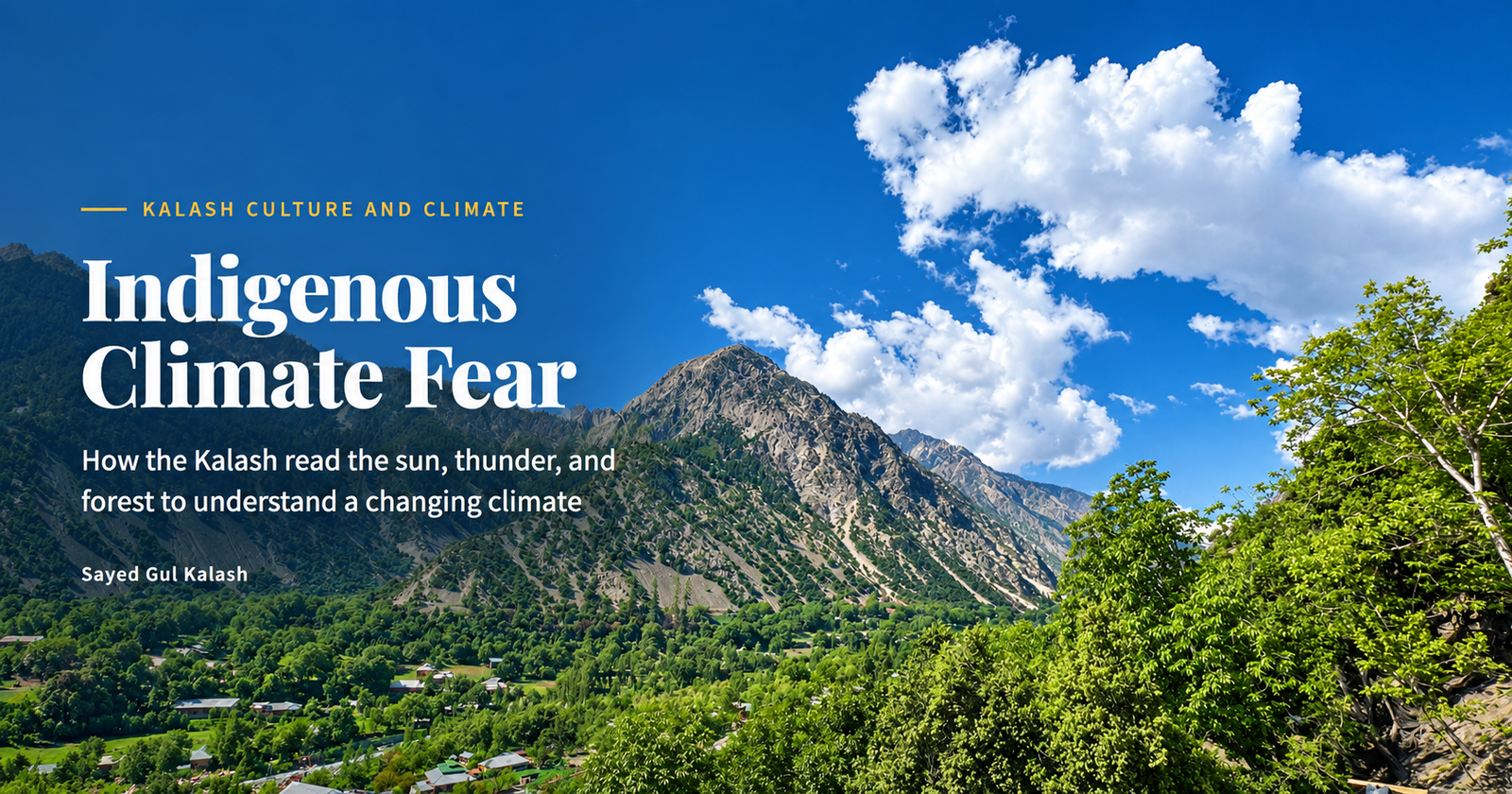
Indigenous Climate Fear: How the Kalash Understand a Changing Climate
When a boy is born, the forest and the trees feel threatened. When a girl is born, the forest and the trees congratulate each other. Qazi Khush Nawaz, 2013
In the Hindu Kush mountains of Lower Chitral, the Kalash people live in three narrow valleys: Rukmoo, Momoret, and Birio. For centuries, distance and hard terrain kept the community fairly isolated, and that isolation helped protect a way of life built around the land, the seasons, and a close spiritual bond with nature.
Today that bond is under strain. Floods, early snow, and long spells of rain are hitting farms, pastures, and homes. Scientists call it climate change. Many Kalash elders see it differently. For them, unstable weather is a sign that people have broken the moral agreement between humans and nature, through mistakes in ritual, disrespect for sacred spaces, or cutting trees out of season.
This article looks at how the Kalash read the sun, the clouds, and the forest to understand the weather, and why their knowledge deserves a place in today’s conversations about climate policy and heritage protection.
Festivals, Rituals, and the Fear of Getting It Wrong
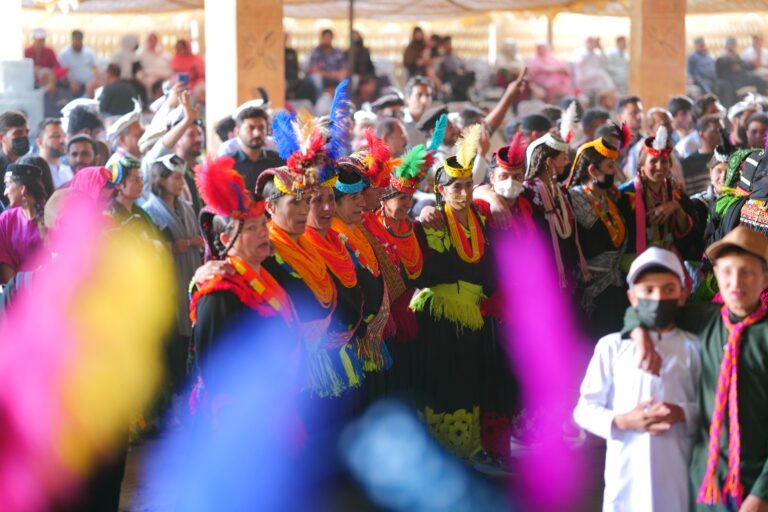
Kalash culture is known far beyond Chitral for its traditions, crafts, and climate rituals, and UNESCO has most recently considered the valleys for World Heritage listing. Much of this heritage lives in the festival calendar:
- Joshi, the spring festival, from 13 to 17 May
- The summer harvest festival, on 21 and 22 August
- Phoo, the autumn harvest festival, held in Birir valley in mid October
- Cewmos, the winter festival and the most sacred of all, from 7 to 22 December
Cewmos carries special weight. The community believes a mistake during its rituals can bring natural disaster. If storms, strong winds, or heavy rain follow the festival, villagers go to predictors, people with specialized spiritual knowledge, to find out why. When a predictor decides the rituals went wrong, the village may have to repeat them according to the sacred protocol. The most common error is failing to follow the rules of purity and impurity during the ceremonies. The belief behind all of this is simple: nature responds to how rituals are carried out.
Onjasta and Pragata: Sacred and Open Spaces
The Kalash divide each valley into two zones. The lower areas are Pragata (open, not secret) and the upper areas are Onjasta (secret and pure). Keeping the two apart is seen as protection against natural disaster. During menstruation and childbirth, women stay in the Bashali, the maternity house in the lower valley, and do not cross the boundaries set long ago by shamans.
Oral history shows what can happen when this order is broken. In the fourteenth and fifteenth centuries, the Kalash were pushed back into these three small valleys and lived through severe hardship. The late Mr. Ayub Khan explained that during that time the Bashali was built in the upper part of the valley. A devastating flood later swept through the whole valley, and the elders tied it to the community’s failure to care for the Onjasta area.
The Warning of 2010
Ae mochbi duniya aas kabarun aa halee.
Translation: Oh people, please take care of the world.
That is how the late Mrs. Murayuk greeted the villagers one morning in 2010. She was deeply respected and people listened to her closely, but the rituals kept being put off. That same year, floods hit the Kalash valleys badly. When villagers came to her asking what to do, she told them it was too late to stop it, but they could still offer sacrifices and ask the universe for forgiveness. In her view, something impure had happened, and the universe was taking revenge.
Mrs. Murayuk was a female shaman who was said to speak with the clouds. Her knowledge went beyond the weather itself, because she always looked for its cause. People in the valley believed that when she spoke to the clouds, the rain would stop and the sun would come out.
Surijagak: Reading the Sun
Watching the sun is one of the oldest Kalash practices and the main way the community tracks seasonal patterns through the year. In the 1960s, Hazar Malik of Krakal village in Bomborate, who held the title of Jangalwal, began matching sun observations with the English calendar so festival dates could be fixed. (Jangalwal was a title the Mehtar of Chitral gave to villagers who worked for him.) The practice, known internationally as Suri Jagek, is listed by UNESCO as intangible cultural heritage in need of urgent safeguarding.
A Sun Observer’s Story
Mr. Malang Khan, a sun observation expert I spoke with in 2022, picked up the practice by sitting with the elders who met at an observation spot near his cattle stable. After his father and grandfather passed away, farming became his responsibility, and he had to learn the timing himself: when to sow seeds, prepare crops, dig the fields, and apply pesticides.
He says the community has always treated sun observation as essential, and that is why it has survived. The elders who once taught it are gone, so his generation now carries the responsibility. Younger people have started learning too.
Winter brings the most people to the observation site, because farm work is light and the sunlight there is especially good. Adults and children gather and wait for the sun to rise at about 9:30 in the morning. The purpose is mainly agricultural, but he believes anyone willing to learn can benefit, and that the knowledge will stay useful for years to come.
When people from the three valleys meet for celebrations or funerals, the talk often turns to the sun. These discussions can get heated, since everyone defends their own reading. Meanwhile, the weather is changing fast. In shaded places such as Gambak and Matang Uch across the river, snow can last until May. In the past, farmers spread soil over the snow so it would melt faster and planting could begin, repeating the process as often as needed.
The Sun’s Winter and Summer Houses
Certain spots matter most for watching the sun, including Sarazarigut, the place of Sarazari. During Cewmos, the sun is believed to rest in its winter house, called toonuna. Around 24 or 25 December, it is believed to begin its journey back.
At the same site where Sarazari is celebrated, people first mark Dauwoo Tatu, the Beans Night festival, followed by Dagari, a single night ceremony of welcoming and wishing through the crow. The ritual cycle continues until Keelaha Saras and ends with Joshi, when the sun is believed to reach its summer house.
Mrs. Murayuk once showed me a huge walnut tree and told me to always remember one thing. When the sun appears between its two branches, it is time for Gonah Joshi, the big Joshi day on 16 May.
Key Sun Observation Points
| No. | Point | Meaning |
|---|---|---|
| 01 | Sarazari Gut | Marks Sarazari, the first day of the winter festival, which begins on 8 December. |
| 02 | Suri Thonona | The house of the sun. |
| 03 | Damaan Mudik | A pasture used as an observation point. |
| 04 | Durrabichao | Means looking at something from inside the house. People say the snow was once so heavy that they had to watch the sun from indoors, and the point took its name from that. |
| 05 | Saat Raat Adua | Means seven days and seven nights. When the sun reaches this point, people pray it does not snow, because they believe snow that falls then will not stop for seven days and seven nights. The phrase is also used for any task that drags on past its time. |
| 06 | Gagas Gagum | Gag means cow and gagum means neck. The name recalls a year when the snow reached a cow’s neck at this point. |
| 07 | Draus Mandolak | A point marked by a small mound of soil. |
| 08 | Samanisar Mudik | Named after the village of Samanisar. |
| 09 | Mosh Thahiken | Mosh are the traditional goatskin shoes shepherds wear in winter, and thahiken means “kept.” The point signals that summer is near, when shepherds put their goatskin shoes away. |
| 10 | Chooth Gola Lansh | A lush green pasture that is well known in the valley. |
These observations continue through the whole year, which is why the Kalash want their children to learn them. The practice builds practical farming knowledge and a deeper understanding of religious and cultural tradition.
The late Mr. Ayub Khan, whom I spoke with in 2019, explained what the length of the sun’s stay in its house could mean. If it stayed three days, people expected floods and uncertainty, while five days pointed to a good year and seven to a balanced one. He also remembered a year when the sun stayed for nine days. The Chitral River froze, and people are said to have played polo on the ice. That year is remembered for hunger, because the long winter kept crops from growing and people faced starvation.
Thunder and Clouds as Signs
The Kalash also watch thunder and clouds for signs of what lies ahead, and the direction of the season’s first thunder matters most. Thunder from the northwest, toward Afghanistan, is a bad omen and has been linked to threats from the Taliban. Thunder from the north is thought to warn of floods and disaster, while thunder from the south signals a good year. Because of this, people watch the sky closely and call each other to confirm where the first thunder came from. When they hear it, they also pray for a good season of mushrooms, grapes, and walnuts.
The Real Custodians of the Forest
A story told in Rukmoo (Ramboor) valley recalls a young girl who stayed in the pastures with her father. Pastures are Onjasta, pure places with strict rules. During her period she did not follow those rules and stayed on in the forest. Suddenly, heavy rain brought a flash flood that tore through the forest. She was at the top of a tree that did not fall, and she vanished with the tree into the flood. People say Ramboor valley has been unstable ever since, and that a single mistake turned the valley toward disaster.
For many Kalash, supernatural beings are the true guardians of the forest. When they feel safe, they protect both people and nature. Deforestation has taken their home away. Bathan Gul, a predictor, and Chichin Bibi, an expert in indigenous knowledge, describe the spirits as crying because they have nowhere left to stay. In their words:
It’s not climate change. It’s nature’s revenge.
Choosing the Rohi Moch (Weatherman)
During Cewmos, the community traditionally chooses a rohi moch, or weatherman. The person chosen holds a central role for the whole year and often gets the credit for good weather or the blame for bad. Oral accounts say that in earlier times, people traveled from Afghanistan to Momoret valley to perform rohi rituals in hard years, blaming misfortune on the weatherman and trying to release him from that responsibility. There are no formal rules about who can be chosen, and in principle any member of the community can be selected. People describe the process as simple and carried out entirely within the Kalash valleys.
Yashi: A Women’s Protest Against Unfair Weather
The Kalash negotiate for everything. We try to talk to the clouds and convince them not to destroy our crops. If the clouds are not convinced, we leave home for Yashi – The late Mrs. Murayuk, female shaman and spiritual leader
Yashi is a small campaign against unfair weather, led by Kalash women. It usually takes place in spring, between March and April, when fruit trees blossom and the forests come back to life. Continuous rain at this time can turn to snow, which puts crops and livelihoods at risk.
First, the community tries to reason with the clouds through the predictors and carries out the needed purification rituals. If that fails, the women leave their homes, walk out into the rain, and begin to migrate. As they walk, they sing:
Yashi parik dai oo Yashi, myta gulotak asta goikani arao ooh.
Translation: We are going for Yashi because the rain will not stop. The fresh cheese has spoiled with maggots from the rain and damp.
Legend says that long ago, women left for Yashi and no one stopped them. They kept walking toward Sityam, the sacred and unknown place Kalash elders believe their people came from, and they never returned. That is why today, when women set out for Yashi, people wait along the way to persuade them to come home and to ask the weather to show mercy on their struggle.
The Emotional Cost of Climate Change
Climate change affects Kalash lives in many ways. It brings food insecurity, the loss of indigenous medicines, and displacement from the land people depend on to keep their traditions alive. When monsoon rains cut off access to food and medicine, mental health suffers as well. For many families, the stress of watching their way of life come under threat has become a real source of anxiety and depression.
In 2019, heavy rain turned into disaster and destroyed the historic Kalash graveyard. Saeed Nisa, a Kalash student and athlete who was 20 at the time, described it this way:
It was so painful to recover the bodies of our deceased relatives. After a huge loss, when you finally try to return to normal life, the universe creates the same situation again. You are helpless, watching everything ruined, trying to figure out where your brother’s grave was. It was not easy when someone called to say my beloved aunt’s body had been found. My grandmother was in so much pain when she heard the news.
What Science Says and What the Elders Saw?
Science has been studying climate change for well over a century. In the 1800s, researchers found that greenhouse gases trap heat in the Earth’s atmosphere. In 1896, the scientist Svante Arrhenius warned that burning coal could warm the planet. Global temperatures have climbed quickly since the 1950s, and concern about rising pollution grew through the 1960s. In 1972, the United Nations Conference on the Human Environment in Stockholm, Sweden, became the first major global meeting on environmental issues.
The Kalash noticed the change in their own way. In October 2005, snow fell before winter had even begun, and people were frightened. The late Mr. Ayub Khan told them it had happened before, and that he had once seen snow in July. The idea of climate change had not reached the valleys then, and Kalash elders still do not accept it as the explanation. They debated and searched for a solution. Mrs. Murayuk told me it happened because we had disrespected nature. She said purification was needed quickly and that trees must not be cut outside the proper season.
Voices like hers matter because most research on indigenous communities is done by outsiders. As a result, the history and heritage of many Native nations have been written and interpreted by people from outside them.
Why Kalash Knowledge Matters?
To understand how the Kalash see climate change, you have to look at their traditional ecological practices, from farming and water management to seasonal rituals. These practices sit at the center of Kalash identity, and for centuries they have helped the community adapt to changes in the environment.
Their oral traditions and community knowledge are essential for understanding local climate shifts and how people respond to them. As floods, early snow, and long rains become more common in the Hindu Kush, this knowledge has real lessons to offer for climate policy, sustainability, and heritage protection. Listening to the Kalash and including their voices in those decisions is one way to make sure it is not lost.
Sources and Interviews
- Dawn, on UNESCO heritage consideration for the Kalash valleys: https://www.dawn.com/news/1995872
- UNESCO, Suri Jagek (observing the sun): https://ich.unesco.org/en/USL/suri-jagek-observing-the-sun-traditional-meteorological-and-astronomical-practice-based-on-the-observation-of-the-sun-moon-and-stars-in-reference-to-the-local-topography-01381
- Personal communication with Mr. Malang Khan, sun observation expert, 2022
- Personal discussions with the late Mr. Ayub Khan, 2019
- Author’s personal experience with the late Mrs. Murayuk, female predictor, 2005 and 2010
- Personal communication with Bathan Gul, predictor, and Chichin Bibi, indigenous knowledge expert
- Testimony of Saeed Nisa, Kalash student and athlete