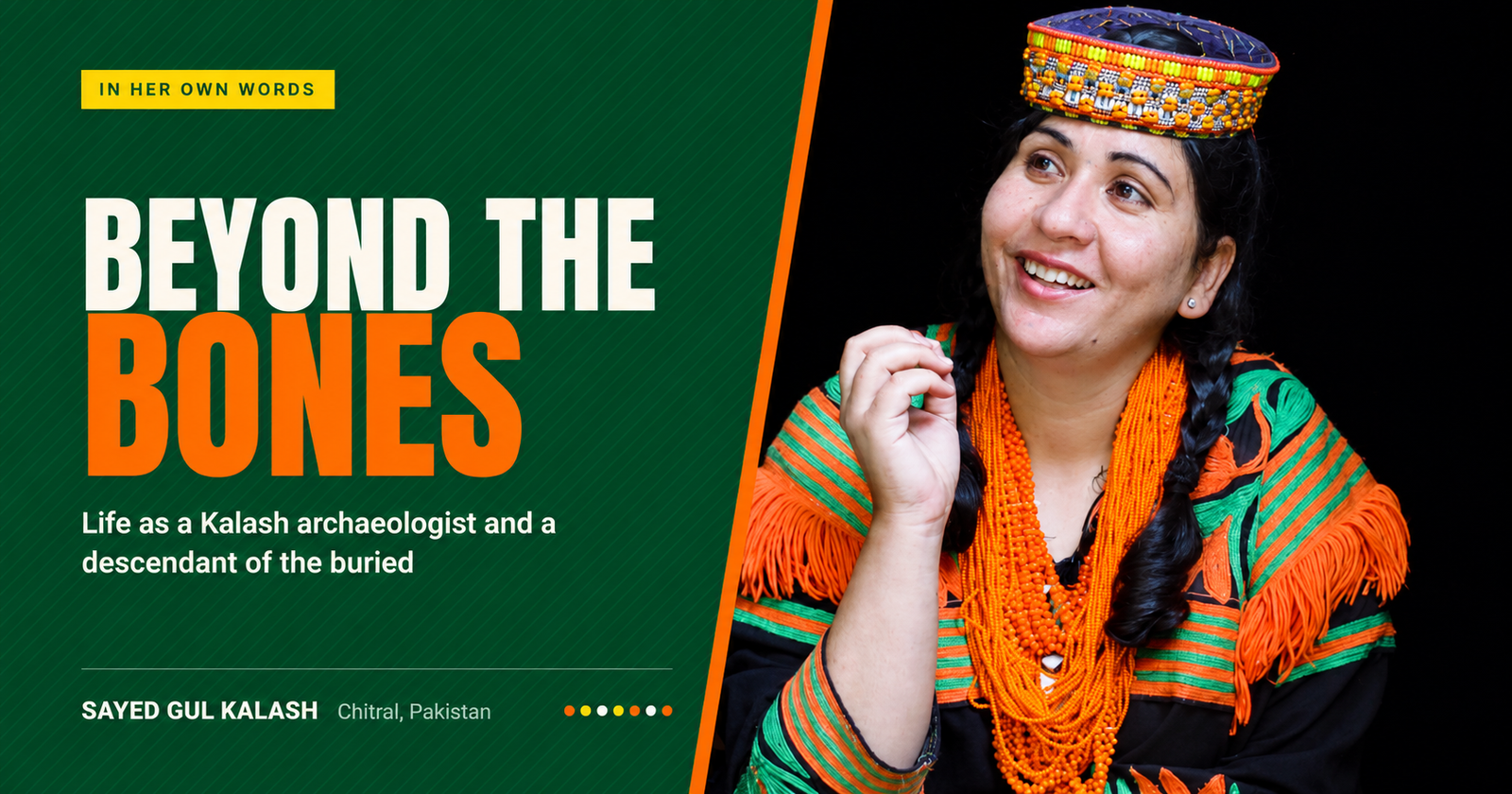
Beyond the Bones: My Life as a Kalash Archaeologist and a Descendant of the Buried
My family passed down stories and traditions for as long as I can remember. As a child, I took them as simple tales about the old days. As I grew older, they turned into questions. Where did my people come from? How did they live? How did they bury their dead?
Archaeology gave me a way to look for answers. It also put me in an unusual position. I study ancient graves for a living, and some of those graves belong to my own ancestors. This is the story of how I got here and what the work has taught me.
How I Became an Archaeologist by Accident?
I never planned to become an archaeologist. In school, I didn’t choose my own additional subjects. The administration chose them for me. In my first year at the Degree Girls College in Lower Chitral, the college clerk picked my subjects. The same thing happened in my third year.
I was the first girl from my community to go into higher education. So I followed whatever advice people gave me. Questioning it never crossed my mind.
After college, everyone had an opinion about my next step. Some said I should do a master’s in sociology. Others thought my confidence made me a good fit for journalism. My own mind kept drifting somewhere else.
Years earlier, I had watched a TV documentary about the Indus Valley Civilization, and it stayed with me. I told my father I wanted to visit those ancient sites. I had no idea a whole subject existed for studying them.
That subject was archaeology. It took me an entire semester just to spell the word correctly. I like to joke that I am destiny’s favorite child, a little nod to Beyoncé. Looking back, the joke feels close to the truth. My curiosity about my community and my love for old civilizations pulled me into this field before I even knew its name.
My First Excavation in Lower Chitral
My first dig came when I was a student, working under my professor, Dr. Muhammad Zahir. The site was Gankorino Taak in District Lower Chitral, Khyber Pakhtunkhwa, Pakistan.
I still remember the thrill. We removed the soil layer by layer, and objects began to appear that people had left behind thousands of years ago. I had never felt anything like it. Every excavation since then has felt like a trip back in time. Each one brings me a little closer to my ancestors and the way they lived.
One dig in Lower Chitral stays with me more than the rest. As we brushed away the dirt, the remains of a young woman came into view. I felt an instant kinship with her. Her bones told us her age and the state of her health. The clothing and jewelry buried with her filled in more of her story. In the end, we could work out how she died.
That moment settled it for me. Archaeology was more than a subject I studied. It became my way to connect with the past and make sense of the present.
What Is the Gandhara Grave Culture?
One of the most important discoveries of my career has been a type of burial site that scholars call the Gandhara Grave Culture. The site I worked on was believed to be over 3,000 years old. It held the remains of people who were likely Indo-Aryan, and very likely my own ancestors.
The name Gandhara appears in ancient texts. It is usually explained as a blend of two Sanskrit words. “Gand” means fragrance and “hara” means land or region. Together they give us “the Land of Fragrance.”
Dani (1992: 395) used the term Gandhara Grave Culture for the protohistoric cemeteries found in ancient Gandhara, which was once a province of the Achaemenid Empire. The first core group of these sites sat in Chitral. Stacul’s brief survey and excavation (1969) later pushed the known range further north. Stacul also recorded similar graves to the east near the Indus (Stacul 1966; 1987: 64 to 65) and to the south in the Vale of Peshawar (Khan 1973: 34).
Early Archaeological Research in Chitral
Before 1999, very little research had taken place in Chitral. The main exception was Stacul’s short expedition in 1968. He found several protohistoric cemeteries near Chitral town (Stacul 1969a: 93 to 95). He also noted how the fertile terraces and fans of the area stood out against the dry, stony valley (Stacul 1969a: 92).
Stacul compared how these graves were built and what they contained. From that, he concluded that they belonged to the Gandhara Grave Culture.
Dr. Ihsan Ali’s Surveys and Excavations
In 1999, Dr. Ihsan Ali carried out a larger survey in the middle Chitral valley. He built on Stacul’s earlier work and also briefly explored the Rumboor valley. The survey lasted two weeks and recorded 18 sites. Most of them belonged to the Gandhara Grave Culture.
Dr. Ihsan Ali then went on to excavate in both Upper and Lower Chitral:
- 2003 to 2004: Parwak village, 95 km northeast of Chitral and 16 km northeast of Buni, on the right bank of the Yarkhun River (Ali & Zahir, 2005)
- 2005: Singoor village, Lower Chitral
- 2007 to 2008: Gankorino Taak, Chitral
These excavations turned up many relics and human remains. They closely resemble finds from Timargarha and Swat. Closer study linked them to both the Kalasha and the Gandhara Grave Cultures.
What the Graves Tell Us About Kalash History and Origins?
The origins of the Kalasha people have puzzled scholars for a long time. Some believe the Kalasha descend from the Greeks. Others trace them to a place called Tsiam. Recent research, including the work in Chitral, points toward a link with the Gandhara region.
Many questions are still open. We don’t yet fully understand Kalash origins, their early history, parts of their religious practice, or how their burial traditions developed. The graves give us some of the best evidence we have.
Pottery, Weapons and Jewelry Found in the Graves
The Chitral excavations produced ceramics, weapons, jewelry, farming tools and finely worked stone pieces.
- Pottery: bowls, ewers, cooking pots and spouted goblets
- Weapons: mostly arrowheads, often placed close to the dead
- Jewelry: hair pendants, finger rings, earrings, bangles and many kinds of beads
- Figurines: terracotta human figures
The beads matter most to me. Kalasha women still wear the same types of beads and shells today. That is a direct thread between the women in these graves and the women in my valleys now, and a clear sign of our Aryan ancestry.
How Kalash Burial Customs Have Changed?
One clear difference separates the Kalasha from the Gandhara Grave Culture. The old graves often held arrowheads and spearheads beside the body. In more recent Kalash burials, a catapult (slingshot) has taken their place.
Small changes like this show how Kalash culture has shifted over the centuries while holding on to its roots.
Excavating the Graves of My Own Ancestors
Most archaeologists study people they have no personal tie to. I don’t have that distance. When I open a grave in Chitral, I am often looking at someone who shares my blood and my cultural background.
I always wanted something I could touch, something beyond the family stories. Archaeology gave me that chance. I knew it would be hard and emotional. I went ahead anyway because I wanted to recover their stories and protect what they left behind.
Standing over those graves hit me harder than I expected. I was literally digging up my own family history. The feeling was powerful and bittersweet at once, and it came with a heavy sense of responsibility.
The rewards have been worth it. Careful excavation and study of the artifacts helped me build a fuller picture of how my ancestors lived. I found details that never came up in any family story. My respect for my own heritage grew with every season in the field.
Staying Objective as a Descendant
My biggest challenge was staying objective. As a descendant, I could easily grow attached to the objects and remains in front of me. I had to keep reminding myself that this was also scientific work. I treated those remains with the same care and respect I would give any other site.
The Ethics of Excavating Ancestral Remains
Ethics were the other hard part. As a member of the descendant community, I had a personal stake in how we handled and explained these remains. I wanted their stories told accurately and with sensitivity. That meant working closely with my community and talking openly with them throughout the work.
When My Community Pushed Back
Not everyone at home welcomed my work. Many people felt I was disturbing the final resting places of our ancestors. Some saw it as disrespect for our traditions. For a long time, I felt caught between my love for archaeology and my duty to my people.
The deeper I went into the research, the clearer things became. My work was about more than ancient civilizations. It was a way to preserve and honor the stories of my own people. Careful documentation gave my community new insight into its own history.
Over time, people stopped seeing my work as digging up bones. They started to see it as a way to honor our ancestors and stay connected to them.
I also came to see my double identity as a strength. Being both an archaeologist and a descendant lets me stand between academia and my community. I can carry knowledge in both directions and share our ancestors’ stories with the wider world.
Protecting Kalash Graveyards and Heritage Today
Early in my career, I worked on several other projects, including dental casting in the Kalash valleys. The projects that involved indigenous communities taught me the most. They showed me that the past includes more than the objects we dig up. It also lives on in the descendants who still keep the customs and beliefs of their ancestors.
Recently, the Directorate of Archaeology and Museums, Government of Khyber Pakhtunkhwa, under the directorship of Dr. Abdul Samad, has preserved the ancient graveyards. The Directorate has also purchased new land for burials for the Kalash community.
This effort has gained real momentum, and I support it fully as an archaeologist and as a descendant. We can study archaeological sites and still respect the spiritual and cultural beliefs of the people tied to them. Finding that balance is how we honor those who came before us.
Through my research and outreach, I want more people to understand why archaeology matters. Our cultural heritage needs protection so future generations can still learn from it.
What Archaeology Gave Back to Me
I went into archaeology to learn about ancient civilizations. Along the way, I learned a great deal about myself. The work brought me closer to my community and gave me a part in protecting our heritage.
The biggest lesson is about responsibility. Knowing where we come from means treating the remains of our ancestors with care. Their stories deserve to be told accurately and with respect, and I will keep doing this work with that care.
I am proud to be a descendant of the buried. I hope my story encourages the next generation to look beyond the bones and find the people and stories waiting underneath.
Frequently Asked Questions
What is the Gandhara Grave Culture?
It is the name scholars use for the protohistoric cemeteries found across ancient Gandhara. Sites have been recorded in Chitral, Swat, Timargarha, near the Indus and in the Vale of Peshawar. Dani used the term to describe these burial sites.
Are the Kalash people connected to the Gandhara Grave Culture?
Excavations in Chitral found relics and burial practices that closely match those of the Gandhara Grave Culture. Recent research links the origins of the Kalasha people to the Gandhara region, though scholars still debate the question.
What was found in the ancient graves of Chitral?
The graves held pottery such as bowls, ewers and spouted goblets. They also contained arrowheads and spearheads, beads and other jewelry, farming tools, stone objects and terracotta figurines.
How are Kalash graveyards being protected?
The Directorate of Archaeology and Museums, Khyber Pakhtunkhwa, has preserved the ancient graveyards. It has also purchased new burial land for the Kalash community.